
Community Champions
Hear from local advocates who champion renewable energy, driving sustainable progress with vision, commitment and a dedication to preserving the future.
Local Economic Benefits

Tilden Solar is anticipated to generate enough solar electricity equivalent to powering the annual electricity use of 33,800 homes.
Tilden Solar created 300 jobs during peak construction and additional long-term positions during the operational phase.
Millions of dollars in taxes will be paid by the project to Randolph County, including to local school districts.

Tilden Solar is anticipated to generate enough solar electricity equivalent to powering the annual electricity use of 33,800 homes.
Tilden Solar created 300 jobs during peak construction and additional long-term positions during the operational phase.
Millions of dollars in taxes will be paid by the project to Randolph County, including to local school districts.

Tilden Solar is anticipated to generate enough solar electricity equivalent to powering the annual electricity use of 33,800 homes.
Tilden Solar created 300 jobs during peak construction and additional long-term positions during the operational phase.
Millions of dollars in taxes will be paid by the project to Randolph County, including to local school districts.
Local Economic Benefits


Community Impact
The project is creating construction jobs, with the majority filled by local hires, working through area unions such as carpenters, operators, and electricians.
It revives a region impacted by the decline of coal mining by transforming a former subsurface mine into a clean energy asset, thus contributing to broader economic revitalization.
Sol Systems is also working with conservation partners to implement ecosystem restoration initiatives, including efforts to promote and preserve native species and pollinator habitat on-site.
On top of millions of dollars in estimated tax revenues, the project will deploy at least 20 years of ongoing investments in local workforce development, community partnerships, and environmental stewardship initiatives to ensure that the benefits of clean energy extend beyond the project itself.
Designed to increase the county’s tax-income revenue as the decline in coal sales tax and coal-fired, this clean-energy initiative is set to revitalize the economic development for the area’s communities.
Economic & Environmental Benefits

No permanent service requirements for the site, meaning no ongoing needs for water, sewer, or other utility services, which significantly reduces operational impacts and resource consumption.

Landowners
As the demand for renewable energy grows, landowners have a unique opportunity to contribute to a cleaner future while benefiting from long-term, stable income. Solar energy projects can provide a sustainable use for large parcels of land, especially for those not currently in active agricultural use or areas with limited development options.
Sol Systems partners with landowners to carefully evaluate the suitability of land for solar development. Our team manages every step of the process, from initial feasibility assessments to the development and operation of solar projects. With a focus on environmental stewardship and community benefits, we ensure that projects align with both your goals and local needs. Learn more about how solar energy can offer a sustainable future for your land.
Project Partners
Our partners share our commitment to clean energy and sustainability, collaborating with us to bring innovative solar projects to life that benefit communities and the environment.




Tilden Solar Fact Sheet
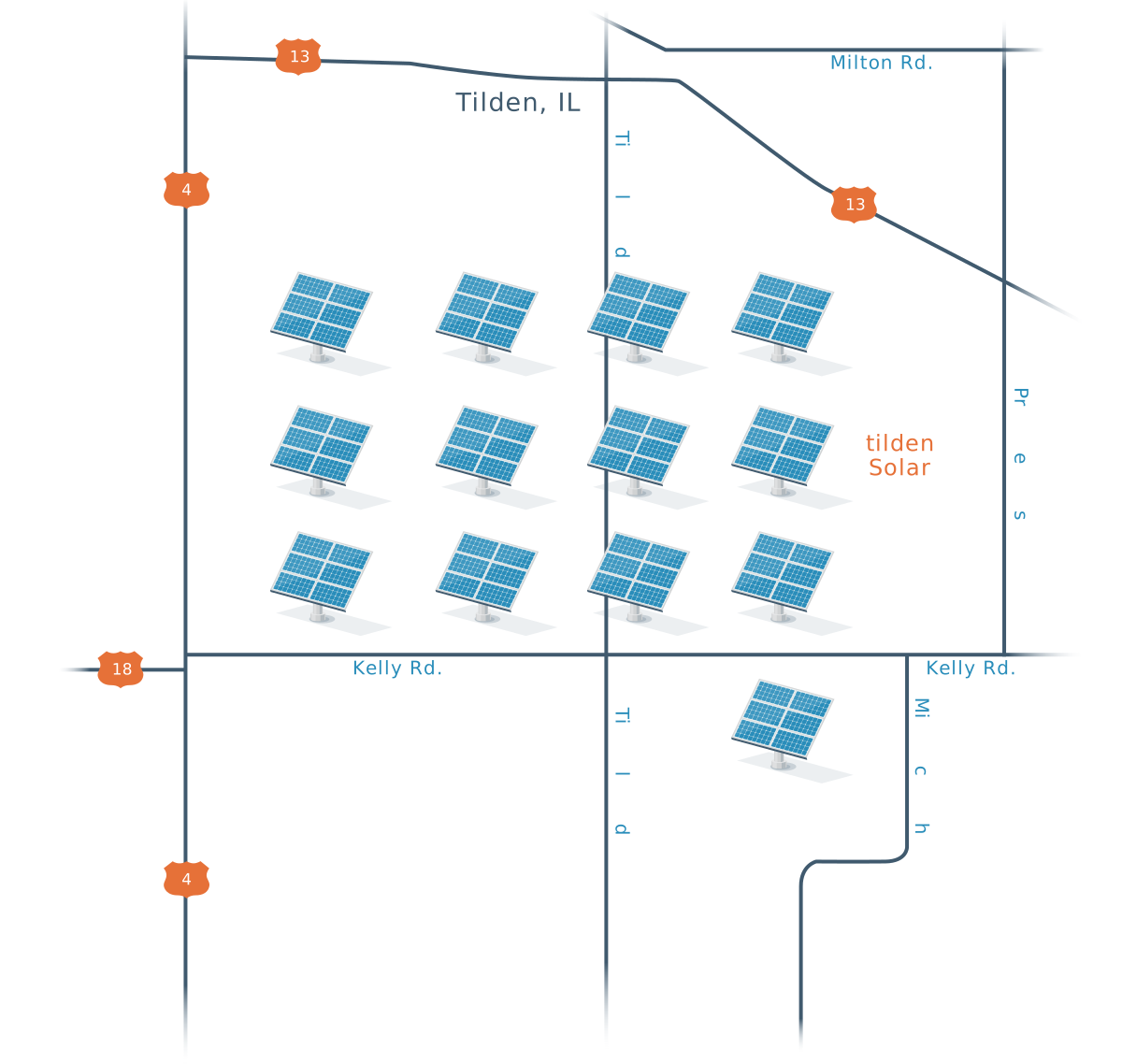
The Tilden Solar facility is located on a historic subsurface coal mine spanning 1,050 acres in Randolph County, Illinois. By repurposing this previously mined land, Sol Systems is driving a transition to clean energy while revitalizing underused property.
View Factsheet
Tilden Solar Fact Sheet

The Tilden Solar Facility is a proposed solar generation facility in northwest Morrow County, Ohio. The facility will have up to 144 MW alternating current nameplate capacity from equipment located in Washington Township in Morrow County.
View FactsheetStudies: Environmental & Technical
Our commitment to quality and sustainability at Sol Systems drives us to go above and beyond industry standards. While not mandatory, we voluntarily conduct comprehensive environmental and technical assessments for our projects. These efforts include rigorous evaluations to ensure that every project is responsibly developed with minimal environmental impact and to proactively address potential concerns before moving forward.
By prioritizing these detailed studies, we maintain the highest level of due diligence, safeguard local ecosystems, adhere to best practices, and ensure the long-term viability of our projects. This proactive approach reflects our dedication to delivering clean energy solutions that benefit the environment and the communities we serve.
The project also completed a first-of-its-kind, multidisciplinary underground mine study to evaluate how to design and operate the array in a way which could handle the expected subsidence from abandoned coal mines beneath the site.
FAQ
What happens to the project when it reaches the end of life?
Sol Systems provides a decommissioning plan. This bond pays for the removal of equipment and any other steps needed to return the land to its original state.
Decommissioning Solar energy Systems Resource Guide – Center for Rural Affairs
What happens when a solar facility is decommissioned? – American Clean Power
The State of Solar Decommissioning Policy: Then and Now – DSIRE insightWill solar panels be damaged by weather events?
Sometimes. Most solar panels can withstand winds of 140 – 160 mph and golf ball-sized hail.
Solar panel damage during weather events is rare with proper installation and maintenance.
Extreme Weather and PV Performance – IEEE Journal of Photovoltaics
Preparing Solar Photovoltaic Systems Against Storms – National Renewable Energy LaboratoryWhat happens to the solar panels when the project reaches end of life?
Solar panels can be recycled or repurposed at the end of their useful life. Sol Systems has partnered with SolarCycle for panel recycling. SolarCycle’s process can extract up to 95% of the value from a panel and supply the recycled material to build new panels.
CCEBA Solar Decommissioning Fact Sheet
Material impacts of PV lifetime and recycling – PLOS One Journal
Evaluation of Potential Health and Environmental Impacts from End-of-Life Disposal of Photovoltaics
End-of-Life Management for Solar Photovoltaics: Recycling – SEIAWhere is power generated by the solar facility being used?
Power is routed to the local electric power grid owned and operated by the utility. From there, power is delivered to utility customers.
How many jobs will this project create?
A 150 MWac project created 300 jobs during the construction period, with approximately 3 permanent full-time jobs for 20+ years.
Are landowners compensated for leasing their property?
Landowners generate a reliable, long-term source of income by leasing their property to solar development.
Will this project impact my monthly electric bill?
Utility-scale projects have no impact on electric bills. The utility company provides electricity to its customers at a set price.
What kind of community benefits does this project yield?
Increased tax revenue for school districts and county departments.
A long-term community benefits program will be launched in the Fall of 2026 to bring economic and environmental benefits to the community.”
Expected increased local spending and sales tax revenue during the construction period.
Energy produced by a 150 MWac solar facility is approximately equivalent to greenhouse gas emissions of 33,800 homes’ annual electricity use.
Renewable energy projects assist states and utilities in meeting clean energy goals.
Can farmland be restored to agricultural use after decommissioning?
Land can be converted back to agricultural use at the end of the facility’s life. Giving the soil 20+ years of rest, or switching to a low-height crop rotation, can also maintain or improve soil quality.
Dual use of solar power plants as biocrust nurseries for large-scale arid soil restoration – Nature Sustainability
Effects of Revegetation on Soil Physical and Chemical Properties in Solar Photovoltaic Infrastructure – Frontiers in Environmental ScienceWhat happens to the tenant farmers of leased solar land?
If the landowners choose to lease the land for the lifetime of the solar farm (20+ years), operations and maintenance of the land shift from the farmer to the solar company. Land leases typically generate more revenue than traditional crops, diversify your income, and remove the risk of poor yield years.
How is vegetation managed under the panels?
With leased land, the leasing party (i.e. utility company/project owner) is usually responsible for upkeep. Many options are available for weed control including herbicides, grazing animals, mowing, and weed control sheets.
Can farming continue on farmland leased to solar development?
Agrivoltaics pair solar with agriculture, creating energy and providing space for crops, grazing, and native habitats under and between panels. Many native plant species and partial-sun crops can grow well under PV panels. In dry areas, some crops even grow better in the shade of PV than in an open field.
Sheep are commonly used for grazing vegetation control at solar facilities, reducing mowing, herbicide, and other vegetation management practices. Farming may also continue outside the fenceline in areas where it makes sense.
Agrivoltaics: coming Soon to a Farm Near You? – U.S. Department of Agriculture
Smart Solar Siting for New England, What is Dual-Use Solar? – American Farmland Trust
Researchers explore dual-use options for solar – Farm Progress
Are solar panels toxic?
No. Solar panels will not harm people, water, or soil. There are no studies indicating negative health impacts from a solar project site. The compounds within solar panels – Cadmium Telluride, Silicon, and others – do not leech, escape, or leak, from solar panels even during extreme weather conditions that damage panels. Materials inside a solar panel are solid and fully encapsulated in tempered glass. All solar panels used by Sol Systems pass the EPA’s Toxic Characteristic Leaching Procedure (TCLP) test, are classified as non-hazardous, and are not regulated as toxic materials. Health and Safety Impacts of Solar Photovoltaics, North Carolina State Extension Publications
Assessment of the Risks Associated with Thin Film Solar Panel Technology – The Virginia Center for Coal and Energy Research
What are solar panels made of?
Crystalline-silicon solar modules are largely made of glass, aluminum, copper, and silicon, along with other commonly used plastic and wires. The cells on solar modules that are used to capture sunlight are made of silicon, which is a naturally occurring element. Crystalline-silicon solar modules are made of basic “solid-state” materials, meaning there are no liquid or gaseous components.
Are solar panels noisy?
No. Inverters used in solar panels can generate a quiet low buzzing sound as they convert DC to AC. The noise generated is generally not audible over ambient noise (rustling wind, birds, traffic, etc.)
Will solar panels produce a bad glare?
Solar panels are intended to capture the most light possible and are designed to reduce reflection and glare. Modern solar panels reduce reflection using anti-reflection coatings (ARC) and texturing the surface. According to the National Renewable Energy Laboratory, solar panels reflect as little as 2% of incoming sunlight and produce less glare than standard windows and water. The Federal Aviation Administration (FAA) produced a final policy report that found solar projects do not create hazardous glare for aircraft in the area.
As the project owner, who is Sol Systems?
Sol Systems is a leading national solar energy firm with an established reputation for integrity and reliability across its development, infrastructure, and environmental commodity businesses. With over 120 employees, Sol Systems has financed or developed over $2 billion of solar, with 2 GW of operating and in-development solar.
How long will construction take?
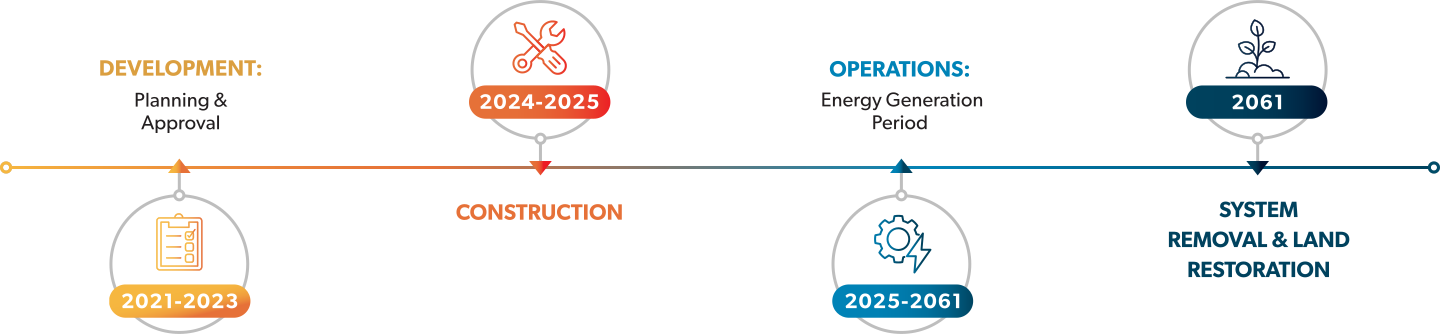
The construction period is expected to last 12-16 months. Construction will begin once all permits are received and pre-construction work and due diligence are completed.
How will the project affect the property values of adjacent and nearby residences?
A recent study focusing on property values around numerous large solar farms in the Midwest has revealed no notable negative effect from the developments. The data suggests a slight positive influence.Gilbert Michaud, a researcher at Loyola University, has participated in numerous community meetings about solar projects, ranging from the Midwest to rural France. In previous studies, he found that concerns over property values were the most frequently mentioned issue during public hearings about utility-scale solar in Europe—a pattern he has also observed in the U.S.Assessing property value impacts near utility-scale solar in the Midwestern United States
American Society of Farm Managers and Rural Appraisers, Inc.
Study of Residential Market Trends Surrounding Six Utility-Scale Solar Projects in Texas
CohnReznick Solar Impact Stud
Will the project be noisy once operational?
The solar project will be a quiet neighbor. Only a few pieces of equipment at the site will make any sound. These are inverters and transformers, and they are equipped with cooling fans. Tech Environmental, Inc. conducted an Acoustic Study, which analyzed noise produced from similar utility-scale solar sites. Based on this report, noise levels approached typical background noise levels within 150 feet of inverter locations.
Will the project impact local roads and traffic?
The public may see or hear construction vehicles transporting material to the site during construction. We will coordinate closely with local and state transportation authorities before, during, and after construction to ensure local roads are cared for, and any necessary road improvement or use permits are obtained.
Why is the solar project located here?
The location for this project was selected based on an assessment of 1) the available transmission network, 2) available substation capacity, and 3) an examination of the landowner’s property to identify the most suitable lands.
Are there coal mines at the site?
Yes, the land used for this project is on top of abandoned coal mines 100-150ft below the surface
Is the site safe for the people given the subsidence?
The expected subsidence shows up on the surface as 1-2ft deep depressions that are as large as a football field. This happens over weeks or months. So, its safe for humans but will leave cracks in homes and could make large structures likes schools, hospitals, and factories unsafe. We’ve developed a first-of-its-kind way to be able to build solar on this site that has limited ability to bring other economic development to the community.